
In this article
Try this experiment: Open any language learning app. Whisper something into it. If you're using Duolingo, Speak, Praktika, ELSA, or TalkPal, watch what happens. The app either doesn't respond or produces gibberish. It might transcribe your whisper as random words. It might miss entire sentences. It definitely won't understand what you said. Now try it on Yapr. Whisper a sentence in Spanish. Portuguese. Vietnamese. Japanese. The app understands you perfectly. This isn't magic. It's a fundamental difference in how these systems process audio. And it reveals something important about what's actually happening under the hood when you speak to an AI language app.
The approach
The Acoustic Reality of Whispered Speech
When you whisper, your voice doesn't just get quieter. It changes completely.
This is the part most people don't realize: whispered speech has a radically different acoustic profile than normal speech. The physics are different. The frequency distribution is different. The signal itself is fundamentally altered.
Here's what happens in your vocal tract when you whisper:
Your vocal cords stop vibrating. Normally, when you speak, your vocal cords vibrate to create fundamental frequency — the pitch of your voice. This vibration is the core acoustic signal that drives normal speech recognition.
When you whisper, your vocal cords don't vibrate at all. You're creating sound through turbulence and friction in your vocal tract instead. The signal is entirely different.
The frequency distribution shifts dramatically. Normal speech has a strong low-frequency component (your vocal cord vibration). Whispered speech has much more high-frequency content (turbulent noise). The spectral tilt — the slope of energy across frequencies — is completely different.
Research has measured the specific acoustic differences:
- The cepstrum distance between whispered and normal speech is about 4 dB for voiced phonemes and 2 dB for unvoiced phonemes
- The spectral tilt of whispered speech is much less sloped than normal speech
- The lower formants in whispered speech shift upward — frequencies below 1.5 kHz are higher in whispered speech than in normal speech
The signal-to-noise ratio drops. Whispered speech is fundamentally quieter and noisier than normal speech. It's harder to extract the actual linguistic signal from the background noise and turbulence.
All of this adds up to one thing: whispered speech is acoustically different enough that it's almost a different modality than normal speech.
The problem
Why STT Models Fail at Whispered Speech
Here's the brutal part: most speech-to-text models are trained exclusively on normal speech.
Systems like Google's Cloud Speech-to-Text, Microsoft Azure's Speech Service, and the original version of OpenAI's Whisper were all trained on massive datasets of people speaking at normal volume, in normal conditions, with normal vocal cord vibration.
These models learned to recognize speech by finding the acoustic patterns that appear in normal speech. They learned to extract the fundamental frequency, find the formants, detect voicing, and reconstruct the phonemes.
None of that works the same way in whispered speech because the acoustic patterns are completely different.
When you feed whispered audio into an STT model trained on normal speech, the model is basically seeing signal it's never seen before. It's trying to apply patterns it learned from normal speech to an audio signal that doesn't have those patterns.
The result: catastrophic failure.
Acoustic mismatch. The primary reason STT systems fail on whispered speech is the acoustic mismatch between the training data (normal speech) and the test input (whispered speech). The model's acoustic features — the features it learned to recognize — don't exist in whispered audio.
Research testing this specifically found that acoustic models trained on normal speech achieve only about 50-60% accuracy on whispered speech. That's barely better than random guessing.
You can improve accuracy slightly (to around 78%) by using MLLR adaptation — a technique that adjusts the acoustic model based on some whispered training examples. But that still requires specialized training data and retraining the model.
Out of the box, standard STT models are essentially blind to whispered speech.
The problem
The Language Learning Problem This Creates
Let's think about where people actually want to practice language:
- On the bus or subway. You're not going to speak at full volume in public. You'll whisper.
- In a shared apartment. Your roommate is sleeping. You whisper.
- At your desk. You're surrounded by coworkers. You whisper.
- In bed at night. It's 11pm and you want to practice before sleep. You whisper.
- In the office. During a lunch break. You whisper.
These are some of the most convenient times to practice language. They're also the times when whispered speech is essential.
Every language learning app that uses STT-based processing is forcing you to choose: practice in situations where it's socially appropriate to speak at full volume, or don't practice at all.
That's not a minor inconvenience. That's a massive barrier to consistent practice.
If you're learning a language in the context of your actual life — work, commute, home, social situations — you're going to spend a lot of time in situations where you can't speak at full volume without looking ridiculous.
An app that can't understand whispered speech is telling you: "We'll help you learn, but only if you can speak out loud."
That's a broken assumption for anyone learning in the real world.
The problem
Why This Reveals the Real Architecture Difference
Here's what's important: the fact that Yapr can understand whispered speech reveals something fundamental about how it's built.
Yapr uses native speech-to-speech processing. Your audio goes in as audio. The model processes the acoustic features directly. There's no transcription step. There's no intermediate text representation.
This means the model receives the full acoustic signal — all of it. The voicing, the unvoiced consonants, the fricatives, the acoustic noise, the frequency distribution. Everything.
When that full signal is processed directly by a multimodal audio model (like Gemini's audio API), the model can handle acoustic variation that would break a text-based pipeline.
Whispered speech is just another form of acoustic input. The model handles it because it's not trying to force the acoustic signal into a text representation. It's processing the audio natively.
This is why apps that use STT-LLM-TTS pipelines struggle with whispered speech: they need to transcribe the audio to text as a first step, and transcription requires the model to have learned the acoustic patterns of whispered speech. Since almost no STT models are trained on whispered speech, they fail.
Apps that process audio natively don't have this problem.
The whisper test is essentially a test of whether the app is actually listening to your voice or just transcribing it. Apps that can understand whispered speech are listening. Apps that can't are transcribing.
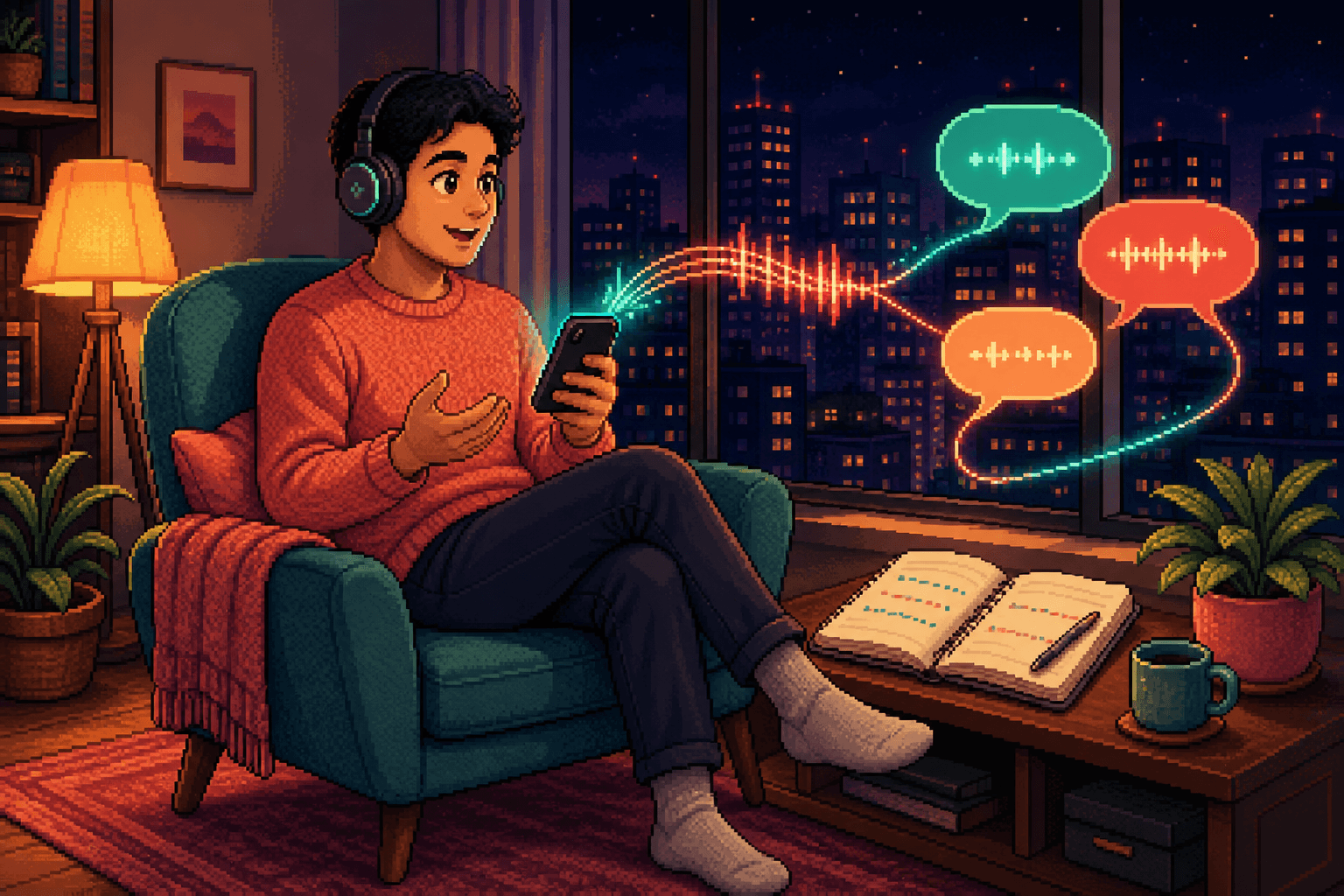
Confidence, one phrase at a time
The comparison
The Practical Difference
Let's walk through what actually happens in each system when you whisper:
STT-based system (Duolingo, Speak, Praktika, ELSA, TalkPal, Langua, Talkio):
- You whisper: "¿Cómo estás?"
- The STT model tries to recognize this whispered audio
- The STT model fails because whispered speech has different acoustic patterns
- It might transcribe it as: "Como esto" or "Komo tas" or something meaningless
- That incorrect transcription goes to the language model
- The LLM tries to respond to an incorrect/garbled input
- You get incorrect feedback or no response
Native audio system (Yapr):
- You whisper: "¿Cómo estás?"
- The multimodal audio model processes the acoustic signal directly
- The model understands you because it's processing the audio, not trying to force it into text
- It generates an appropriate response
- That response comes back as audio
- You get accurate feedback in real time
The difference is absolute. One works. One doesn't.
The problem
Why Most Apps Haven't Solved This
The answer is simple: they can't without major architectural changes.
Companies like Duolingo and Speak built their systems around STT-LLM-TTS because that was the viable architecture in 2020-2023. To support whispered speech, they would need to:
- Collect large datasets of whispered speech in their target languages
- Retrain or fine-tune their STT models on this data
- Deploy the new models across their infrastructure
- Deal with the added latency and complexity
That's expensive and difficult. It's also a band-aid solution. Even with retraining, the fundamental problem remains: you're still forcing audio through a text bottleneck.
The proper solution is native audio processing. But that requires rebuilding the entire architecture from scratch.
Yapr was built this way from day one. We didn't have to retrofit whisper support into a text-based system. We processed audio natively, so whisper support came naturally.
The problem
The Broader Implication: What Gets Lost in Transcription
The whisper problem is just the most obvious example of a larger issue: transcription-based systems lose information that native audio processing preserves.
When you force audio into text, you lose:
Acoustic features that don't map to phonemes: Whispered speech is the extreme example, but there are subtle acoustic variations in normal speech that contain meaningful information. When you transcribe to text, that information vanishes.
Paralinguistic information: Your tone, hesitation, confidence, accent variations — these are all acoustic features. Text doesn't capture them. An LLM has no idea how you sounded.
Pronunciation nuance: An STT model might transcribe your Spanish with a terrible accent as "correct" text, and then the LLM responds based on the transcription, never knowing you mispronounced something badly.
Dialect and variation: Whispered speech is a form of acoustic variation. So are regional accents, age-related vocal changes, and emotional coloring of speech. Text-based systems struggle with all of these.
Native audio processing preserves all of this information. The model hears what you actually said, with all its acoustic nuance intact.
The approach
Testing This Yourself
If you want to experience the difference directly, here's what to do:
- Open a standard STT-based language app (Duolingo Max, Speak, Praktika, etc.)
- Whisper a simple sentence: Something like "Hello, how are you?" in your target language
- Observe what happens: Most likely, the app either doesn't respond or produces incorrect output
Now compare:
- Open Yapr
- Whisper the same sentence at the same volume
- The app understands you perfectly and responds in real time
That difference isn't a feature. It's a fundamental architectural difference. You're comparing text-based processing to audio-native processing.
The whisper test is one of the simplest ways to tell whether a language app is actually listening to your voice or just transcribing it.
The approach
What This Means for Real-World Learning
Here's the bottom line: language learning happens in the real world, not in a soundproof booth.
Real-world practice means practicing on the bus, in your apartment, at work, in bed at night. These are situations where you'll whisper a lot of the time.
An app that requires you to speak at full volume isn't designed for real-world learning. It's designed for controlled, sterile practice in artificial conditions.
Yapr works in the real world because it understands real-world audio. Whispered speech, normal speech, accented speech, fast speech, slow speech. The audio-native pipeline handles it all.
You can practice how and when you actually want to practice. Not when the app's speech recognition model trained on normal speech allows you to practice.
Sources:
- Whispered Speech Recognition Based on Audio Data Augmentation and Inverse Filtering | MDPI
- Gladia - AI Model Biases: What went wrong with Whisper | Gladia Blog
- Acoustic analysis and recognition of whispered speech | IEEE
- Whispered Speech Database: Design, Processing and Application | Springer
- Investigation of Whisper ASR Hallucinations Induced by Non-Speech Audio | arXiv
Yapr is a voice-first language learning app built on native speech-to-speech AI. Understands whispered speech, normal speech, accents, dialect. Audio in, audio out. Try it free at yapr.ca.
Yapr is a voice-first language learning app built on native speech-to-speech AI.
Understands whispered speech, normal speech, accents, dialect. Audio in, audio out. Try it free at yapr.ca.
Practice privately, at your pace, with zero judgment.