In this article
Your tía says something in Spanish and everyone laughs. Your parents smile. You're smiling too, but you have no idea what she said. You laugh anyway, that hollow laugh you've perfected over twenty-some years of family gatherings where your first language became your second, then third, then the one you pretend you never spoke at all. This is what "no sabo" actually means. Not "I don't know"—that's the literal translation. It means this feeling. The shame of recognizing your own language and not being able to claim it. The cultural whiplash of understanding everything in your bones but nothing in your mouth. If that lands different, you're not alone. Researchers tracked heritage Spanish programs in American universities and found explosive growth: 22% increase between 2002-2012. That's not coincidence. That's millions of kids like you deciding that the disconnection ends now.
The approach
The Guilt That Doesn't Get Talked About
Here's what nobody tells you: the guilt is worse than the inability.
You can't speak Spanish? That's a solvable problem. Tools exist. Apps exist. You can practice.
But the guilt—that your parents sacrificed to give you opportunities, and one of those sacrifices was their language. That they stopped speaking Spanish at home to help you assimilate. That when your abuelo calls and your mom has to translate because you can't, there's this moment of silence that says everything.
And the flip side: the expectation. Your cousins who grew up in Mexico, they expect you to speak Spanish. The Spanish teacher in high school expected you to be fluent because of your last name. Your heritage community expects you to be a bridge back to your culture, even though you never asked to be that bridge.
You're caught between two worlds—not immigrant enough, not American enough. Spanish enough to feel the loss, not enough to claim fluency.
The research on heritage speaker identity is clear: this disconnection has been happening for generations, and it's actively constructed in family dynamics around language choices made decades before you were born.
The problem
Why You Understand But Can't Speak
There's a reason for this, and it's not because you're lazy or your parents failed.
You grew up hearing Spanish. You absorbed rhythm, vocabulary, maybe even grammar patterns you don't consciously recognize. Your brain has the input. But your mouth never had to produce it. When everyone in your house switches to English—which happens, because English is the lingua franca of American schools, workplaces, and everything that signals "success"—your brain stops treating Spanish as something you need to speak. It becomes passive knowledge. Survival-mode understanding. Enough to catch context and names but not enough to construct a sentence under pressure.
This isn't a language problem. It's an exposure problem. And exposure problems have solutions.
The growing recognition of heritage speakers as a distinct learner category means the educational world is finally catching up to reality: you're not a "beginner." You're not a "native." You're something different, and you need an approach that speaks to your specific situation—one that builds on passive comprehension instead of starting from zero.
The approach
What Reconnecting Actually Looks Like
It doesn't look like Duolingo. You don't need to learn "el gato"—you already know that. You don't need a gamified tree of vocabulary. You need a way to take what's already in your head and push it out of your mouth.
You need practice that feels like talking to family, because that's the real goal. You want to call your abuela and have a conversation. You want to make a joke in Spanish and know your own aunts laughed because you're funny, not because they're being nice.
The best heritage speaker learning isn't flashcards or grammar drills. It's conversation. Real, unscripted, messy conversation where you say something wrong and someone corrects you and you keep going. Where you stumble through a sentence because you're thinking in English and you can hear it, but you finish the sentence anyway.
Most apps can't do this. They use the same text-based pipeline for everyone—speech gets transcribed to text, text gets processed, response gets turned back to speech. Three separate systems stitched together. For heritage speakers, this is brutal. You're trying to activate something that's dormant, and that requires precision feedback on exactly how you sound. Text-based systems miss that. They transcribe what they think you said, not what you actually said, which means they miss your accent, your hesitation, the specific pronunciation patterns that mark you as someone learning their own language, not a tourist picking up Spanish for a beach vacation.
You need an app that hears you the way another Spanish speaker would hear you. Not through a transcription filter. Directly.
Confidence, one phrase at a time
The approach
The Whisper-in-Bed Reality
Here's something nobody talks about in the heritage speaker recovery community: you're not going to practice at 10 AM with perfect diction.
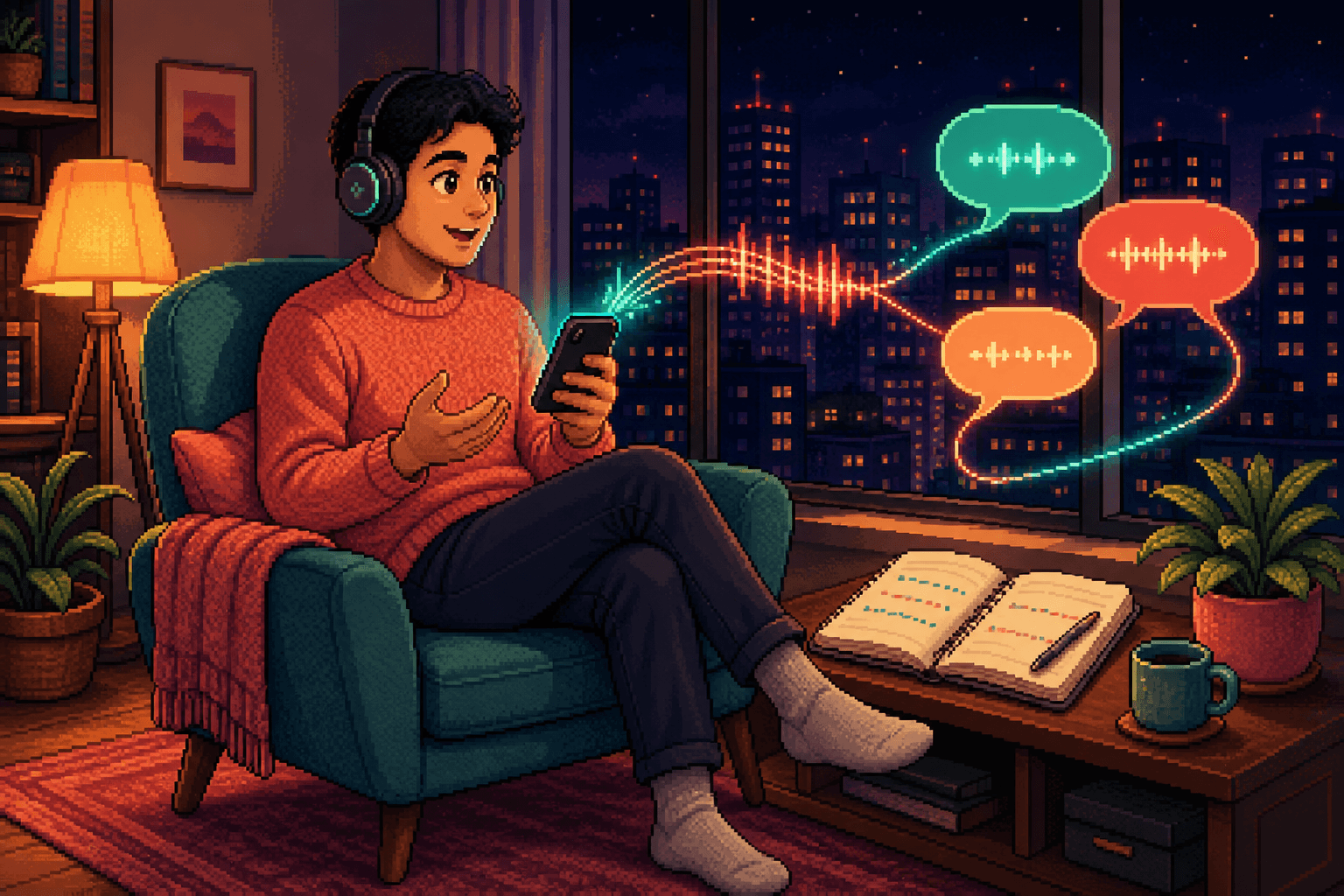
You're going to practice at 11 PM lying in bed, whispering into your phone because your roommate is sleeping. You're going to practice on the bus with earbuds in, mouthing words, not speaking them out loud. You're going to practice in your car on the drive home, voice low, because the idea of your coworkers hearing you stumble through Spanish is mortifying.
Every other app falls apart when you whisper. Speech-to-text models are trained on normal-volume, clearly articulated speech. They were built for people confidently speaking into microphones. Whispered audio has a completely different acoustic profile—your vocal cords aren't vibrating the same way, the frequency distribution shifts. Standard STT just gives up. It returns gibberish or nothing.
If you're going to practice in the margins of your life—and you are—you need an app that understands you when you're not speaking at full volume. You need one that processes audio natively, the way a human ear would, not through a transcription layer.
The approach
Beyond No Sabo: Ownership
The real shift happens when you stop thinking of Spanish as "my parents' language" and start thinking of it as yours.
You're not recovering something you lost. You're claiming something that was always yours to begin with. Your Spanish doesn't need to match your abuelo's Spanish or your cousins' Spanish or some textbook standard Spanish. It needs to be your Spanish—the one that comes from growing up between worlds, from thinking in English and speaking in Spanish, from understanding the cultural weight of both languages at the same time.
Heritage speaker programs focus on developing cultural competence alongside language skills for exactly this reason. Learning Spanish as a heritage speaker isn't about becoming a native speaker who left the country. It's about building your own relationship with your culture, in real time, at your own pace, without shame.
That's not remedial. That's authentic.
The approach
Starting Now
The guilt comes from years of silence. Starting is the hard part. Not because you don't know Spanish—you do, somewhere deep. But because speaking it out loud requires vulnerability. It means accepting that you'll sound like someone learning their own language, and that's okay.
You need a practice environment where:
- You can stumble without feeling watched
- The app understands you when you're quiet, in bed, not performing
- Feedback actually reflects how you sound, not a text approximation
- You're not constantly comparing yourself to native speakers or textbook standards
- You can build conversation confidence before real family calls
The difference between apps here matters. Most language learning tools are built for tourists or career professionals trying to pick up a language from zero. They're not built for heritage speakers who need precision audio feedback, sub-second latency to feel like a real conversation, and the ability to practice anywhere—including whisper-quiet, late at night.
Yapr is specifically built for heritage speakers like you. It uses native speech-to-speech processing, which means it hears you the way another Spanish speaker would. Not a transcript. Not an approximation. Your actual voice, with your actual accent and your actual hesitation patterns. That precision feedback is what turns passive comprehension into active fluency.
And it supports 47 languages with accent and dialect variation—including Mexican Spanish, Castilian Spanish, Colombian Spanish, Caribbean Spanish. Your Spanish. Not the standardized version.
The approach
The Conversation You've Been Waiting For
In a few months, your abuelo calls. You answer in Spanish. Not perfectly. But fluently enough to hold a real conversation. You make a joke. She laughs—the laugh that says she's laughing at what you said, not at you.
That moment happens when you finally believe you're allowed to speak your own language.
Start at yapr.ca. The no sabo kids are already there.
Start Speaking Today
Try Yapr free — real conversations, 47 languages, zero judgment.
Practice privately, at your pace, with zero judgment.